
The framework
The AI Sandwich Methodology
A practical framework for AI projects that actually ship — and stick.
The real challenge of AI is human, not technological.
Billions have been invested into AI, yet ROI remains elusive for most businesses. The surprising truth: it's not the technology. It's the gap between having AI and making it work for non-technical people who must adopt it daily.
The AI Sandwich is built on a simple observation — successful AI implementations balance three layers. Skip any one, and the project fails. Most organizations skip two.
Three layers. All required.
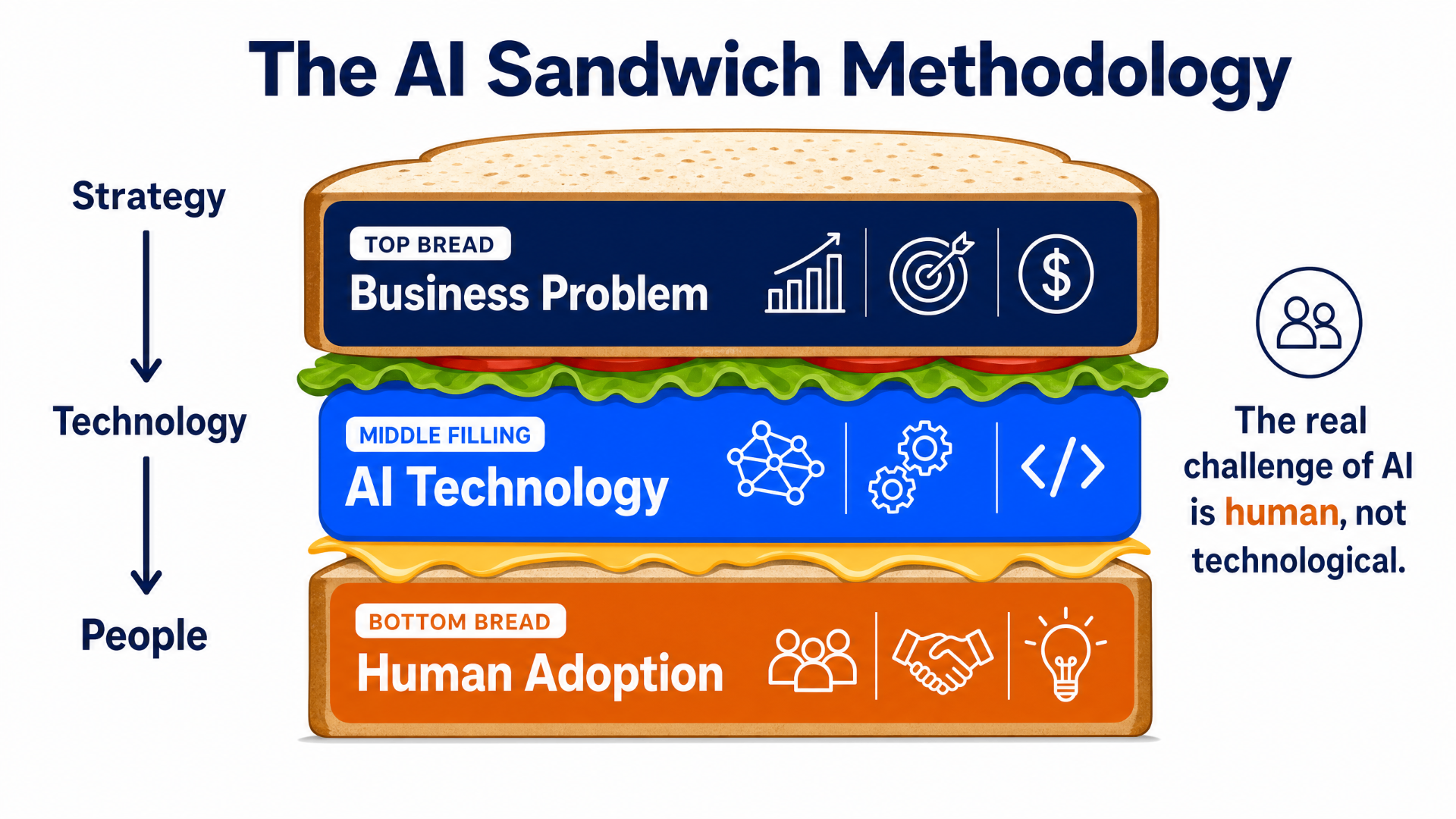
Strategy · Market validation · Constraint analysis
"What real problem are we solving that requires AI?"
Most AI projects start with a model and look for problems. Reverse it. Pin down the business problem first, validate it with users, and only then ask whether AI is the right tool.
Model selection · Architecture · Data pipelines
"What is the right AI approach for this specific problem?"
Build vs. buy vs. fine-tune. Vertical AI vs. horizontal. Open-source vs. frontier API. The right answer depends entirely on the layer above and the layer below.
Change management · Training · Trust-building
"How do we get people to actually use this?"
70% of employees need additional training to work effectively with AI tools. Less than 30% of CEOs directly sponsor their AI agenda. Adoption is where most projects die — and where the AI Sandwich invests the most.
From AI ambiguity to actionable outcomes in 2–4 weeks
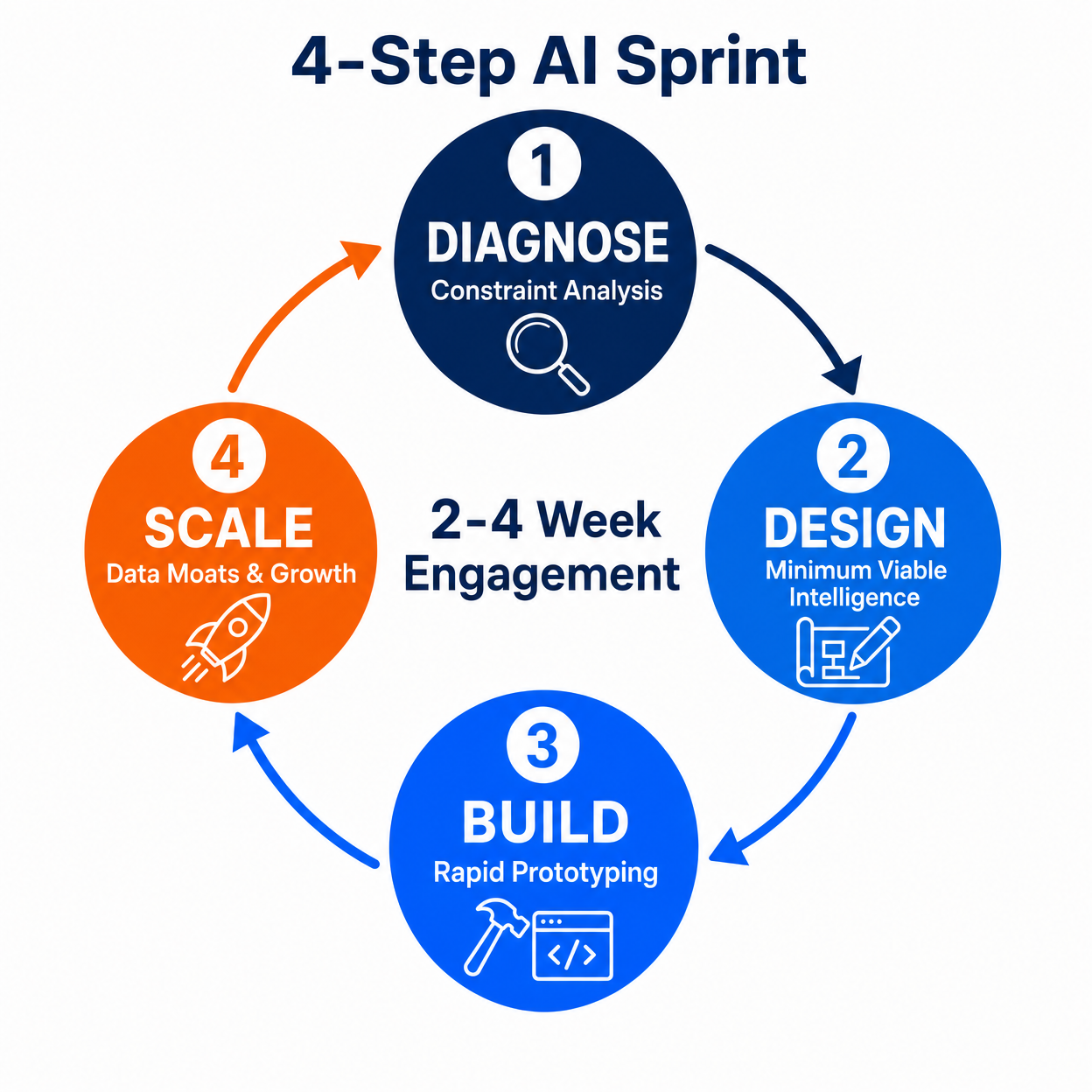
1. Diagnose — Constraint Analysis (Week 1)
- Identify the real bottleneck: data, distribution, team, or timing
- Map current workflows and pain points
- Assess data readiness and quality
2. Design — Minimum Viable Intelligence (Week 1–2)
- Define the smallest AI-powered feature that proves value
- Choose vertical AI over horizontal
- Build vs. buy vs. fine-tune decision framework
3. Build — Rapid Prototyping (Week 2–3)
- Ship a working prototype in days, not months
- Use existing models and APIs where appropriate
- Validate with real users immediately
4. Scale — Data Moats & Growth (Week 3–4)
- Build proprietary data feedback loops
- Establish measurement framework
- Create defensibility through compounding data advantage
Your data compounds. Their API access doesn't.
One of the most common startup mistakes: building a thin UI on top of a frontier model and calling it a product. The model is a commodity. Your defensibility lives in the data only you have.
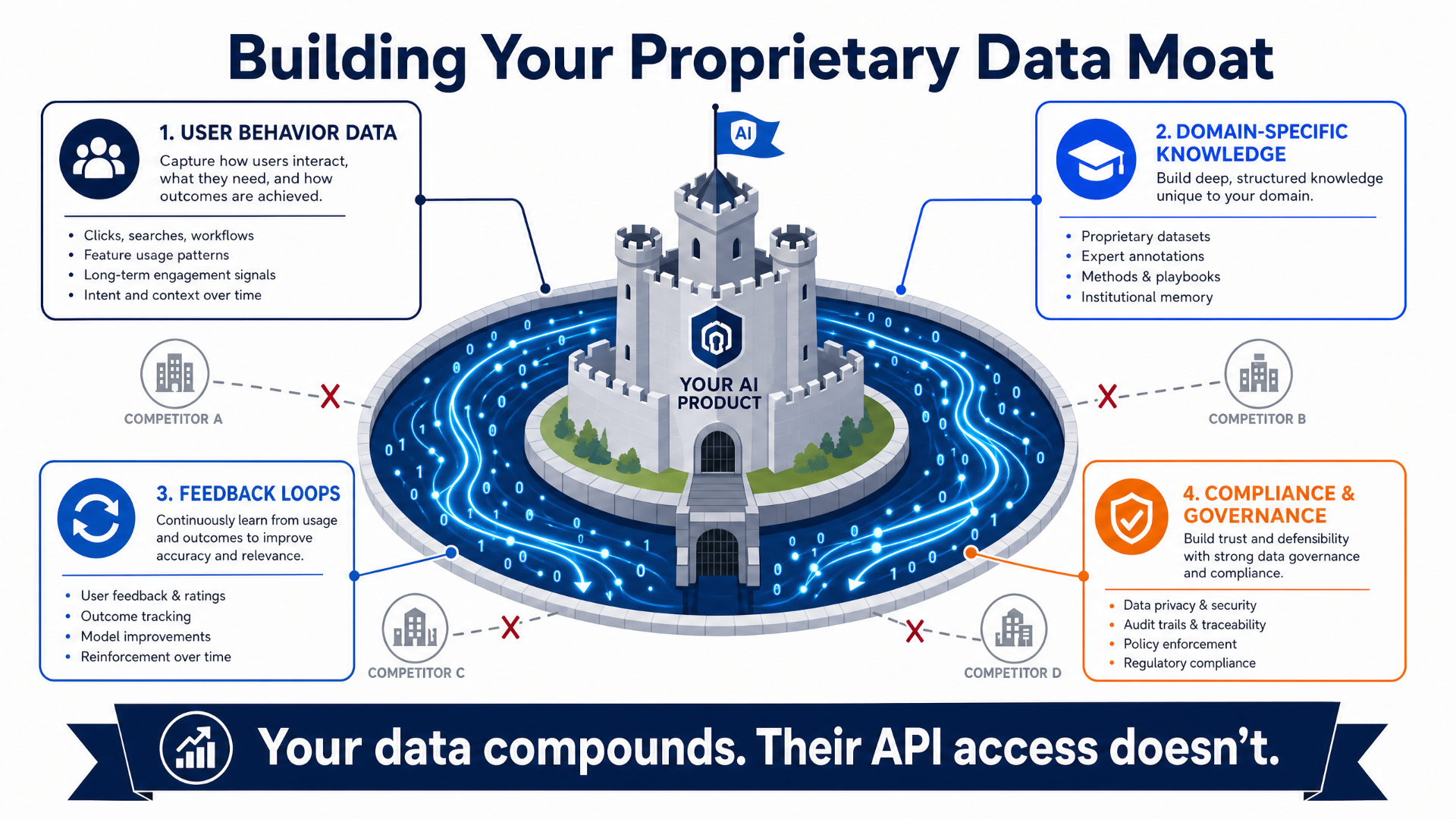
User behavior data
Clicks, searches, workflows, and intent over time
Domain-specific knowledge
Proprietary datasets, expert annotations, playbooks
Feedback loops
User ratings, outcome tracking, model improvements
Compliance & governance
Data privacy, audit trails, policy enforcement
If you can't measure it, you can't scale it.
AI impact is fully measurable — but it requires the same rigor as any capital investment. Five layers, five owners, five sets of KPIs.
| Layer | Focus | Example KPIs | Owner |
|---|---|---|---|
| Financial Impact | Enterprise value | Revenue uplift, cost-to-serve reduction, TCO | Finance / FP&A |
| Strategic Outcomes | Business performance | NPS, satisfaction, retention, compliance | Business Unit GM |
| Operational KPIs | Process improvement | Cycle times, defect rates, cost per case | Process Owner |
| User Adoption | Engagement & trust | DAU, workflow penetration, AI acceptance vs. override rate | Product Leader |
| Technical Performance | System health | Hallucination rate, latency, token cost, drift | Engineering |
Adapted from McKinsey & Company, "From Promise to Impact" (April 2026)